
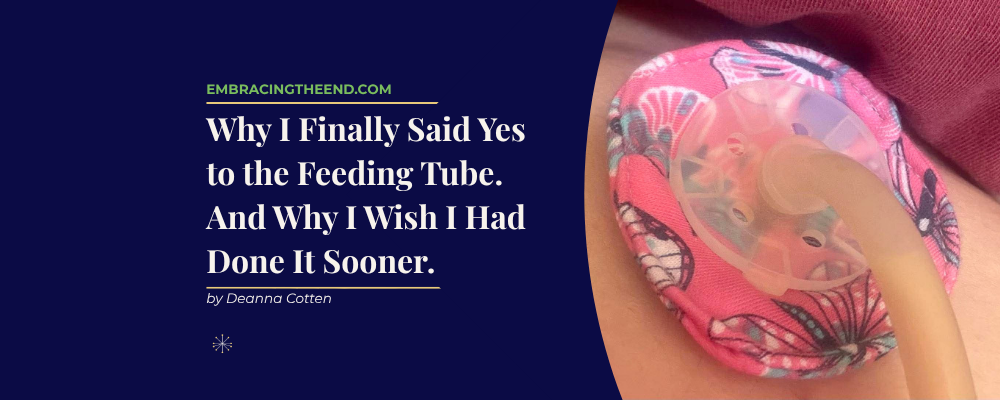
I finally said yes to a feeding tube nearly two years after my ALS diagnosis and seven months after graduating from hospice.
And I am so thankful I did.
Getting a PEG tube has been hands down one of the best decisions I’ve made for my quality of life. But I will be honest with you because that’s what we do here. I had a lot of mind drama around this decision. For a long time the answer was no. Hard no. I didn’t want it and I was afraid it would prolong this disease longer than I wanted to live it.
I know I’m not the only one who’s felt this way.
The Fear Is Real.
When you’re living with a terminal disease the last thing you want is something that might keep you here longer to suffer. That fear is valid. I’m not going to minimize it.
But here’s what I have come to understand after walking through this myself.
The body knows how to die.
When it’s time, the digestive system will naturally begin to shut down and stop accepting nutrition. It’s not something I will have to fight against or make a decision about in that moment. My body will make that call on its own. While it is true that a feeding tube can potentially prolong life, it won’t override the dying process. It simply supports my quality of life until it’s time to die.
I’m not sure what took so long for those dots to connect. I deserve to feel my very best for the time I have left.
Nutrition plays a significant role in quality of life and comfort. Energy levels, mental clarity, strength, mood. All of it’s connected to what my body is taking in. When I was relying on ice cream and Pepsi for my primary nutrition because those were the easiest things to get down, things weren’t going well. And yes I love my Pepsi. But a girl cannot thrive on Pepsi alone, as much as I have tried.
What Life With a Feeding Tube Actually Looks Like
I still eat regular food. I want to be clear about that because I think a lot of people assume a feeding tube means you stop eating entirely. Although that is the case for many with ALS who’ve lost their ability to swallow, that’s not the case for me.
I can still eat anything I want. But swallowing is significantly harder now. My pharyngeal muscle has little to no response which makes moving food from my throat to my esophagus more difficult. Chewing for long periods is also exhausting in a way that is hard to explain until you have experienced it. So I tend to stick with softer easy to chew foods and drinks. I try to eat at least one small meal a day and I snack a lot. And of course, I always have a Pepsi.
But my primary nutrition now comes through my feeding tube. Which means on the days I don’t have the energy to eat or I’m struggling more than usual I know my body is still getting what it needs. And I can enjoy the foods I love without the pressure of needing them to keep me alive.
Beyond nutrition the feeding tube has also been a game changer for hydration and medication. Staying hydrated is harder than most people realize when swallowing is compromised. The tube makes it simple. And for medications that are difficult to swallow or need to be administered consistently, the tube provides direct access without the struggle. It’s one less thing to manage on the hard days and that matters more than I can explain.
The Risks Worth Knowing
A feeding tube isn’t without risks and I want to be honest about that too. The risks were part of my hold up all along.
The most common risks with PEG tube placement include infection at the insertion site, leaking around the tube, accidental dislodgement and aspiration if formula is administered too quickly or the person isn’t positioned correctly. For people with already compromised respiratory function like me the placement procedure itself carries some additional risk because the procedure may (but not always) require sedation.
Timing matters with a disease like ALS.
If you’re considering a feeding tube your medical team will likely recommend doing it before your respiratory function declines too far for the procedure to be safe. That’s part of why I wish I’d done it sooner.
Granulation tissue around the insertion site is also common and requires ongoing care. And like any medical device a feeding tube requires a learning curve for both the patient and the caregiver managing it. It’s manageable but it’s not nothing.
Talk to your ALS care team about the specific risks for your situation. What’s right for me may not be right for everyone and timing is everything with this decision.
Please Stop Forcing Your Loved One to Eat.
Food is a way we show people we love them. It comes natural for us as humans. But for the love of all things holy… please don’t force your terminally ill loved one to eat or drink. If someone you love is in the late stages of a terminal illness and they’re not eating or drinking much anymore… THIS IS NORMAL! They’re not starving. Their body is doing exactly what it’s supposed to do.
As the body begins the natural process of dying the digestive system slows down and eventually stops accepting food and fluids. This isn’t a crisis. It’s not something to fight against. It’s the body’s wisdom doing what it knows to do.
Forcing food or liquids at this stage can actually cause harm. Aspiration, which happens when food or liquid enters the airway instead of the stomach, becomes increasingly dangerous as swallowing muscles weaken. Forcing someone to eat or drink when their body isn’t ready to receive it can lead to aspiration pneumonia which is one of the most common causes of death in ALS patients. It’s painful and at times it’s preventable.
I know it comes from love. The instinct to feed someone you love, to nourish them, to keep them here a little longer is one of the most human things there is. But sometimes the most loving thing you can do is sit with them, hold their hand and let their body lead.
If your loved one is declining their intake talk to their hospice team or palliative care provider. They can help you understand what’s normal, what’s comfortable and how to support your person without causing unintentional harm.
Would I Do It Again?
Without hesitation. Yes.
The feeding tube gave me back energy I didn’t know I was missing. It gave me clarity. It took pressure off of every meal and every swallow. It let me enjoy food again for the pleasure of it rather than the survival of it.
I wish I’d said yes sooner. But I said yes when I was ready and that matters too.
If you are sitting with this decision right now I’m not here to tell you what to do. I’m here to tell you I totally understand the mind drama you are working through. Talk to your team. Ask every question. And give yourself grace for wherever you land.
A feeding tube doesn’t mean you’re giving up. You’re giving yourself the best possible chance to feel your best for as long as you’re here.
And that’s always worth saying yes to.
For more on the hard decisions that come with ALS read The Hard Decisions to Make With ALS.
Both of my books were written from inside this journey including the feeding tube decision and everything that came after.
Embracing the End was written while fighting for my life in hospice. Grab a signed copy here.
Embracing the End… Again was written when I unexpectedly didn’t die and had to figure out what comes next. Grab a signed copy here.
Want both? Grab the complete bundle and save with free shipping.
Disclaimer: I’m not a doctor or medical professional. Everything I share on this site is based on my own personal experience living with ALS. Nothing on this site should be used to diagnose, treat or make medical decisions. Please consult your healthcare provider for medical advice specific to your situation.


Leave a Reply