
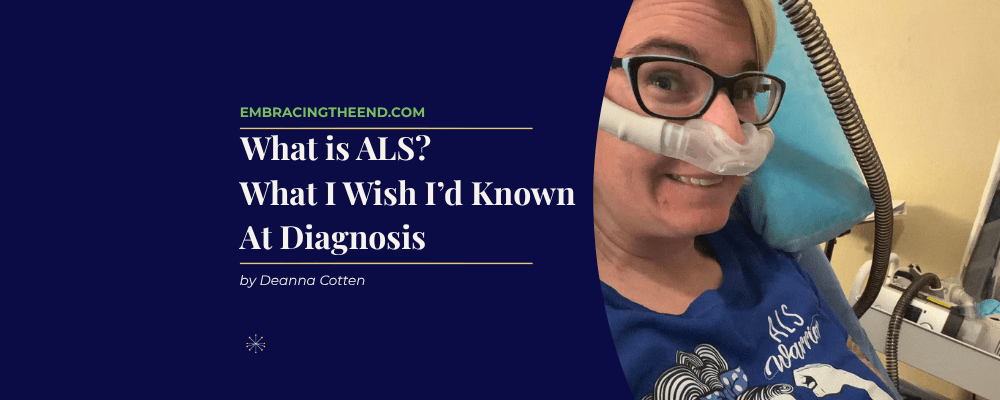
When I received my ALS diagnosis in January 2024, I had no idea what it was. Up to that point, I believed everything was figureoutable.
Looking back, I’m actually grateful for that. I walked into that doctor’s office without a Google-fueled panic spiral. I hadn’t spent months or years believing I was dying but nobody would make the call. I’d been following up on my symptoms without years of dread and preloaded fear.
But thousands of people right now are sitting in ALS groups and forums, terrified, searching for answers, watching their bodies do things they can’t explain and wondering if this is it.
This post is for them. And for anyone who loves someone with ALS. And for anyone who just wants to understand what this disease actually is… in plain human language, not medical jargon.
So… What Is ALS?
ALS stands for Amyotrophic Lateral Sclerosis. ALS is more commonly known as Lou Gehrig’s disease, named after the baseball legend who was diagnosed in 1939.
It’s a neurodegenerative disease. That means it attacks the nervous system, specifically the motor neurons that control voluntary muscle movement. These are the muscles that help you walk, talk, eat, and breath. Over time, the brain loses its ability to communicate with the muscles. Muscles weaken. Functions are lost. One by one.
It’s also 100% fatal. There is no cure.
The average prognosis at diagnosis is 2 to 5 years, though the reality is far more complicated than that number suggests. Some are gone in a matter of days to months. Others far outlive the standards.
Why Is ALS So Hard to Diagnose?
There is no single test that can diagnose ALS. You can’t look at ALS under a microscope. You can’t stage it the way you stage cancer. There’s no blood test, MRI or CT scan that says yes or no. Instead, ALS is diagnosed by ruling out everything else first. Doctors must eliminate a long list of diseases that can look exactly like ALS, including strokes, tumors, nerve compressions, Multiple Sclerosis, Myasthenia Gravis, Lyme, Spinal Muscular Atrophy, Kennedy disease to name a few.
Once those are ruled out, doctors use biomarkers and a test called an EMG (electromyography) to build the case for an ALS diagnosis. The EMG measures the electrical activity in muscles and has significantly improved the ability to diagnose ALS earlier and more accurately.
The Diagnostic Standards
Over the years the medical community has developed formal standards to help doctors diagnose ALS consistently. The three main ones are:
The El Escorial Criteria, developed in 1990 and revised in 1998. The Awaji Criteria, developed in 2006, which integrated EMG findings more directly into the diagnostic process. And the Gold Coast Criteria, the most recent standard developed in 2019 to simplify the diagnostic process and improve early detection.
Each standard has improved on the last. The Gold Coast Criteria in particular has shown a diagnostic sensitivity of up to 92% compared to around 88% for the earlier standards. Progress is being made. But it’s still far from a simple process.
The Misdiagnosis Problem Is Real
ALS is most often missed rather than misdiagnosed. In more than half of ALS cases, patients are initially misdiagnosed or given alternate diagnosis before receiving an ALS diagnosis. Most often told their diagnosed with cervical myelopathy, neuropathy, myasthenia gravis or another neurological condition. Sometimes, patients have other diagnostic factors alongside ALS, causing much confusion for healthcare providers.
More than half of people living with ALS initially received a false negative, meaning they’re told they have something else entirely before ultimately receiving their ALS diagnosis.
These are real people losing precious months… sometimes years… without access to the treatments, clinical trials and support systems they need and deserve.
On average, diagnosis takes between 10 and 16 months from symptom onset. For a disease with a 2 to 5 year prognosis, that delay is devastating. At diagnosis, I noted I’d had obvious symptoms for 16 months. After my doctors looked further, my shortness of breath started three years earlier while fighting COVID-19. The shortness of breath never got better, rather it progressed into a restrictive lung pattern, common with neuromuscular disease. So, it’s possible my initial onset was three years prior to my ALS diagnosis.
Every patient deserves a definitive diagnosis. The fear of being wrong should never come at the cost of a patient’s time, dignity and access to health care.
Why Progression Looks Different for Everyone
ALS does not follow a script. It’s literally has no rhyme or reason. We are all fighting the same battle with the same outcome, but not one of us looks exactly the same. Some lose everything and wait for their ability to breathe to shut down. Others walked themselves to bed the night they died.
We all share the same symptoms. Progressive muscle weakness, loss of speech or disturbances, difficulty swallowing, and breathing complications. But the order these symptoms arrive, the speed at which they progress and the parts of the body affected first can look completely different from one patient to the next.
That makes it difficult for a doctor to easily assess each patient for a diagnosis. Often times, physicians generate their idea of what progression should look like based on the handful of cases they’ve treated. The liklihood that your doctor hasn’t treated an ALS patient is highly probable. In this case they may rely heavily medical journals presenting an average case or progressive outlook, causing you to feel unheard or unseen.
A disease with no rhyme or reason that’s fatal doesn’t come with a time stamp. It’s nearly impossible to look at someone with ALS and tell them exactly how long they have.
The best tool available for tracking individual progression is the ALSFRS-R, the ALS Functional Rating Scale Revised. It is not perfect but it is the most useful thing we have. It scores function across a range of activities to track how the disease is moving. I hope that the ALSFRS-R is somday updated to track cognition as well.
When I was diagnosed, my pulmonary functions had already declined significantly. My score at diagnosis put 70 to 80% of patients with similar scores at a nine months survival rate if progression continued at it’s current rate. And then ALS did what ALS does. It had its own agenda.
For a season it progressed fast. I went on hospice 10 months after diagnosis. Then it slowed. When i wasn’t expected to live, I made a miraculous turn-around. Then it plateaued. I graduated from hospice care 4 months and rolled outta that facility and didn’t look back. It’s been a tough road to rehabilitating. ALS is still progressing, but I’m home and thriving.
There’s no straight line with this disease. It speeds up, slows down and surprises you at every turn.
Living Inside the Uncertainty
Over the first few months to year after diagnosis, you’ll spend a lot of time looking back at what you have lost. I remember thinking six months ago I was paddle boarding and now I need a cane or a walker to keep me from falling. Three months ago I was running to a flight in Nashville and today I need a wheelchair to get me through Walmart.
Losing my ability to drive.
That was the hardest.
I knew as soon as I was putting the car in park at stop signs and red lights that driving was a liability. I didn’t want to admit it, but I was putting other people in danger as well, so my doctor made the call. I look back now and think just two years ago, I could come and go as I pleased. Today, I have to arrange a caregiver for every appointment, coffee date or shopping trip.
But, the hardest part of ALS isn’t any single loss or symptom.
It’s learning to live fully in the present while navigating new losses, and preparing for the losses that haven’t arrived yet. It’s the six months or less mentality that never fully leaves even when you’re years past that mark. It’s the emotional drain of preparing for the worst while refusing to stop living.
Finding a version of normal inside this disease is hard. But it’s not impossible.
I’m living proof!
We were all handed a death sentence, I just received mine in writing. We woke up today. So let’s make today count!
If this resonated with you, both of my books were written from inside this journey.
Embracing the End was written while fighting for my life in hospice. Raw, honest and yes… occasionally funny. Grab a signed copy here.
Embracing the End… Again was written when I unexpectedly didn’t die… and had to figure out what comes next. Grab a signed copy here.
Or grab both and save with The Complete Bundle.
Disclaimer: I’m not a doctor or medical professional. Everything I share on this site is based on my own personal experience living with ALS. Nothing on this site should be used to diagnose, treat or make medical decisions. Please consult your healthcare provider for medical advice specific to your situation.


Leave a Reply