
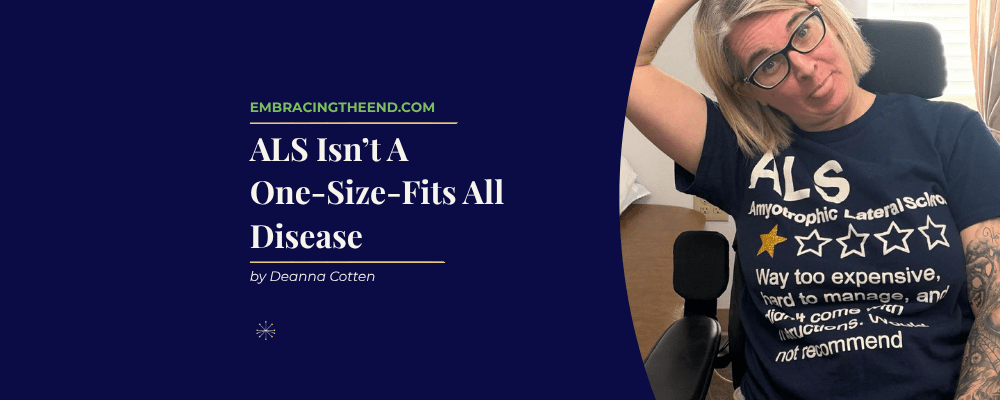
When I was diagnosed, I had no idea ALS was. More importantly, I didn’t realize this wasn’t a one-size-fits-all diagnosis that came with textbook treatments and understanding across the scope of healthcare. I’d heard of it once before when a friend’s husband was diagnosed but even then I didn’t understand the full weight of what that family was carrying. I certainly didn’t know enough to advocate for myself. And I had absolutely no idea that I was experiencing one of the rarest presentations of an already rare, complicated and devastating disease.
What followed was a crash course in self advocacy that I never asked for and couldn’t afford not to take.
First, What Kind of ALS Are We Talking About?
Before we get into onsets it helps to understand that ALS itself falls into two broad categories based on cause.
Sporadic ALS is the most common form accounting for roughly 90 to 95% of all cases. It occurs with no clear inherited cause and can affect anyone at any age though it most commonly appears between the ages of 40 and 70. Nobody fully understands why sporadic ALS develops in the people it develops in. It simply does.
Familial ALS or genetic ALS accounts for roughly 5 to 10% of cases and occurs when a mutation is passed down through families. Of familial cases about 20% involve a mutation of the SOD1 gene and about 2 to 5% have mutations of the TDP-43 gene. If you have a family history of ALS genetic testing and counseling are worth discussing with your neurologist. ScienceDirect
Regardless of which category you fall into the disease is the same in its outcome. 100% fatal. No cure. No way out. What differs is how it begins and how it progresses and that difference matters enormously for diagnosis, treatment decisions and quality of life planning.
The Three Primary ALS Onsets
Where ALS begins in the body is called the onset and it shapes everything about how the disease presents, how quickly it’s diagnosed and how it progresses.
Limb onset is the most common form present in up to 75% of ALS patients. It begins with weakness in the hands, arms, feet or legs. Someone with limb onset might notice they are tripping more often, dropping things unexpectedly, struggling to button a shirt or finding that one hand or foot simply isn’t responding the way it used to. Because limb weakness is visible and measurable it’s often easier for doctors to identify and track. This is the presentation most people picture when they think of ALS.
Bulbar onset accounts for about 25% of ALS cases and begins with weakness in the muscles of speech, chewing and swallowing. Someone with bulbar onset might notice slurred speech, difficulty swallowing, changes in voice quality or trouble chewing certain foods. Patients with bulbar onset ALS typically experience shorter survival times and more rapid decline compared to those with limb onset. Bulbar onset is becoming more widely recognized but still catches many patients and families off guard because the first symptoms can easily be mistaken for stroke, thyroid issues or other neurological conditions.
Respiratory onset ALS is uncommon accounting for less than 3% of ALS cases. It begins with breathing difficulties, shortness of breath during exertion or at rest, or difficulty breathing while lying flat. Because respiratory symptoms can be attributed to so many other conditions, from asthma to COPD to heart disease to deconditioning, respiratory onset ALS is frequently the last thing anyone considers. That was certainly true in my case.
My Experience as a Respiratory Onset Patient
I didn’t present or progress like classic ALS. That confusion has cost me critical time with my family and friends.
Looking back I’d been experiencing shortness of breath for three years before my diagnosis. I’d attributed it to long haulers Covid. My doctors were aware of the symptoms I was experiencing, but tests weren’t showing anything obvious. And, they admitted that medical science really didn’t understand enough about Covid at the time to fully understand what I was experiencing. It wasn’t until I was struggling to writethat I realized there’s something significant going on. At the same time I was struggling to hold up my core in my chair at work. None of these symptoms formed an obviuos answer.
It wasn’t until I found myself running through an airport terminal, feeling my ankles collapse and my lungs burning in a way that didn’t make sense for someone who used to run 5Ks before work, that I started to understand something was seriously wrong.
Even after my diagnosis I found myself navigating not just a rare and confusing disease but an even rarer onset within that disease. Multiple doctors disagreed with my diagnosing physician constantly. I didn’t look like their idea of an ALS patient. I wasn’t presenting the way their textbooks and diagrams had taught them to expect. Meanwhile my pulmonary functions were declining rapidly and I was getting worse regardless of what any disagreeing doctor believed about my case.
I’m deeply grateful for the few doctors who set aside the disagreements and served me as their patient first. They ensured I had everything I would need as the disease progressed. Because it did progress. Fast. And being prepared made all the difference.
I had no choice but to become an expert on my own diagnosis. Through that process I finally understood why ALS is so difficult to diagnose and why my case in particular had created so much confusion. I didn’t look like the typical patient because there is no typical patient. We all have the same symptoms but never in the same order or at the same time. ALS is everything but an obvious diagnosis.
Beyond the Three Main Onsets
There are additional presentations of ALS that often fall under one of the three primary categories but are distinct enough to carry their own names. Flail Arm Syndrome and Flail Leg Syndrome are rare variants of ALS characterized by predominant weakness and atrophy in either the upper limbs or lower limbs respectively without significant involvement of other muscle groups. These syndromes may progress more slowly than typical ALS and often have distinct clinical features.
Multi-focal ALS is another variant where symptoms appear in multiple regions simultaneously rather than spreading from a single point of origin. Each of these presentations adds another layer of complexity to an already complicated diagnostic picture.
A Word to Those Still Searching for Answers
Many people with ALS symptoms already suspect they’re fighting this disease long before any doctor makes the call. That gap between knowing something is wrong and receiving a definitive diagnosis is one of the most frustrating and isolating experiences in the ALS journey. It’s also one of the most dangerous because every month without a diagnosis is a month without access to clinical trials and treatment options that could potentially slow the progression of the disease. It also delays access to resources and services that could meaningfully improve quality of life.
If you’re in that gap right now I want you to hear this clearly. You have every right to push your doctors to pursue answers. Not to push for an ALS diagnosis specifically but to push for an explanation of what is happening in your body. You deserve to be treated with dignity and respect and part of that is identifying what is wrong so you can access the treatment options and support you need.
There’s something both maddening and oddly reassuring about ALS. If it’s truly ALS, it’ll eventually rear its ugly head regardless of what any doctor believes today. This disease will eventually makes itself known. But you shouldn’t have to wait in silence in the mean time.
If you’re struggling to be heard consider seeking out a patient advocate through your hospital’s social services department or searching for a private patient advocate in your area. Having a third party who isn’t emotionally overwhelmed by your situation can mean the difference between wasting precious appointment time and actually getting answers.
You’re not imagining this so keep on pushing for answers.
The One Thing Every ALS Onset Has in Common
Limb. Bulbar. Respiratory. Flail Arm. Flail Leg. Sporadic. Familial. Every single presentation of this disease leads to the same place. It is 100% fatal. There’s no cure. Regardless of how ALS starts it will end the same for every one of us.
Unless of course you get hit by a bus or struck by lightning first. Which is always still possible.
To understand more about the basics of ALS read What Is ALS? What I Wish I’d Known At Diagnosis.
Both of my books were written from inside this journey including the respiratory onset confusion, the doctors who dismissed me and everything that came after.
Embracing the End was written while fighting for my life in hospice. Grab a signed copy here.
Embracing the End… Again was written when I unexpectedly didn’t die and had to figure out what comes next. Grab a signed copy here.
Want both? Grab the complete bundle and save with free shipping.
Disclaimer: I’m not a doctor or medical professional. Everything I share on this site is based on my own personal experience living with ALS. Nothing on this site should be used to diagnose, treat or make medical decisions. Please consult your healthcare provider for medical advice specific to your situation.


Leave a Reply