
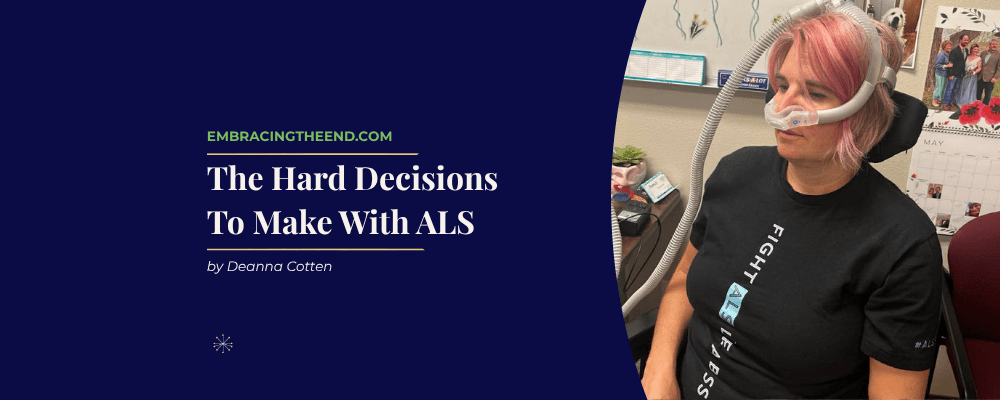
Some of the hardest decisions you’ll ever make with ALS have nothing to do with bucket lists or goodbyes. They’re the quiet, deeply personal decisions about breathing support, nutrition, hospice and palliative care. And for those living in states or countries where Medical Aid in Dying is legal, that adds another layer of complexity to an already overwhelming landscape of end-of-life wishes.
Nobody hands you a guide for these decisions. Nobody warns you that the person you are today at diagnosis may feel completely differently days, week and months from now. And nobody tells you that changing your mind isn’t only allowed, it might be the most courageous thing you do throughout this journey.
Where I Started
At diagnosis I made what felt like clear and simple decisions. I wouldn’t use any form of mechanical ventilation. I didn’t want anyone I loved to face the decision of turning it off someday. That felt like a gift I could give them. I was DNR under all circumstances. And initially I decided I wouldn’t use a BIPAP machine or any form of breathing support at all.
Then the disease showed me what it actually meant to be respiratory dominant in progression.
I was still somewhat mobile. I was still able to be social. I still had a life I wanted to be present for. And I had to re-evaluate. While I held firm on mechanical ventilation, I decided that BIPAP therapy would give me a quality of life that allowed me to feel my best in the condition I was in at that time. That decision felt like a betrayal of my earlier self for about five minutes. Then it felt like wisdom.
When the Ground Shifted Again
About six months after diagnosis I had a significant decline in my pulmonary function test despite using the BIPAP. My doctor believed I could be within six months of passing if the disease followed its natural course. I decided to stop using my BIPAP because I felt it wasn’t working and I was ready to let the disease take its course.
Less than two months later I was ready for home hospice.
Just six weeks after starting home hospice I developed aspiration pneumonia followed by a severe UTI. Both are common infections at the end of life. One year after my diagnosis I was placed in a hospice facility at my own request. I wasn’t expected to live through the weekend.
But then… PLOT TWIST!
I survived.
My new book Embracing the End… Again tells the full story of the darkness that unfolded during my four month stay at that hospice facility and what it took to come out the other side. Because I did come out the other side. I graduated from hospice care.
Within two months of titrating off the comfort medications I’d been on, I became very uncomfortable again. So I made the hard decisions again. I went back on my BIPAP machine and I got a feeding tube.
The Feeding Tube Decision
Most people with ALS are encouraged to consider nutritional support via feeding tube at diagnosis, even if they don’t need it yet, and there are real reasons for that conversation happening so early. Eating uses far more energy than most people realize. Weight loss is expected because of muscle loss, swallowing challenges and the sheer effort that eating requires as the disease progresses. Good nutrition can meaningfully improve quality of life and provide support on the harder days when energy is lowest.
I had so much mind drama over this decision. I didn’t want to take any life saving measures. Despite every decision that I’d gone back and forth on, life-saving and life-prolonging options were still a no for me. I wanted to feel my bestm, but I had no desire to drag out life with this disease any longer than absolutley necessary.
I understood a feeding tube wouldn’t save my life but I was scared to manage one more thing and terrified of one more avenue for infection after months of fighting infections back to back. The hesitation felt rational at the time.
Three months after returning to BIPAP my pulmonary function test revealed another significant decline. My pulmonologist and my primary care doctor both flagged it simultaneously. If I was going to consider a feeding tube, the time to make that decision was now, before my function declined further and the procedure became riskier.
I got the feeding tube. And within weeks I saw weight gain, increased energy levels, improved mental clarity and a quality of life I hadn’t experienced in months. I wish I hadn’t waited as long as I did. It was one of the best decisions I made in this entire journey.
On Prolonging Life Versus Living It
Some people opt out of these measures entirely, afraid of prolonging a life they are ready to release. I can relate! That is a deeply personal and completely valid choice. What I want you to know is that breathing support and nutritional support will not save your life. They can improve the quality of the life you are still living, but they will not change the outcome. As Hospice Nurse Julie says, “the body knows how to die.” Part of the natural dying process is the digestive tract shutting down. When that begins to occur your body will naturally reject tube feeds regardless of what decisions you’ve made.
At diagnosis I believed these interventions were life-prolonging measures and I had no interest in extending my time with this disease beyond what was absolutely necessary. What I discovered along the way was that I still had reasons to be present. I still had peace about dying and I didn’t expect breathing or nutrition support to keep me alive indefinitely. I was simply hopeful that they would help me feel my best during whatever time I had left.
That distinction changed everything for me.
It Is Okay to Change Your Mind
I want to say this as clearly as I possibly can because I needed someone to say it to me, and I’m thankful they did.
It’s okay to change your mind. It’s okay to re-evaluate along the way and make decisions that fit best for who you are and where you are right now in this moment. The person you are at diagnosis doesn’t have to be the person who makes every decision for the rest of your journey. You are allowed to grow into new information, new circumstances and new reasons to stay as long as you feel your best.
Your decisions about breathing support, nutrition, hospice and palliative care are yours alone. Nobody else gets to make them for you and nobody else gets to judge them. Evaluate them regularly, communicate them clearly to the people you love and give yourself permission to change them when your circumstances change.
That isn’t weakness. That’s wisdom.
For more on end of life planning and the decisions that come with a terminal diagnosis read Normalize Talking About Death and Dying and Don’t Wait to Do These 5 Things After Your ALS Diagnosis.
Both of my books were written from inside this journey including the hospice story and everything that came after.
Embracing the End was written while fighting for my life in hospice. Grab a signed copy here.
Embracing the End… Again was written when I unexpectedly didn’t die… and had to figure out what comes next. Grab a signed copy here.
Want both? Grab the complete bundle and save with free shipping.
Disclaimer: I’m not a doctor or medical professional. Everything I share on this site is based on my own personal experience living with ALS. Nothing on this site should be used to diagnose, treat or make medical decisions. Please consult your healthcare provider for medical advice specific to your situation.


Leave a Reply