
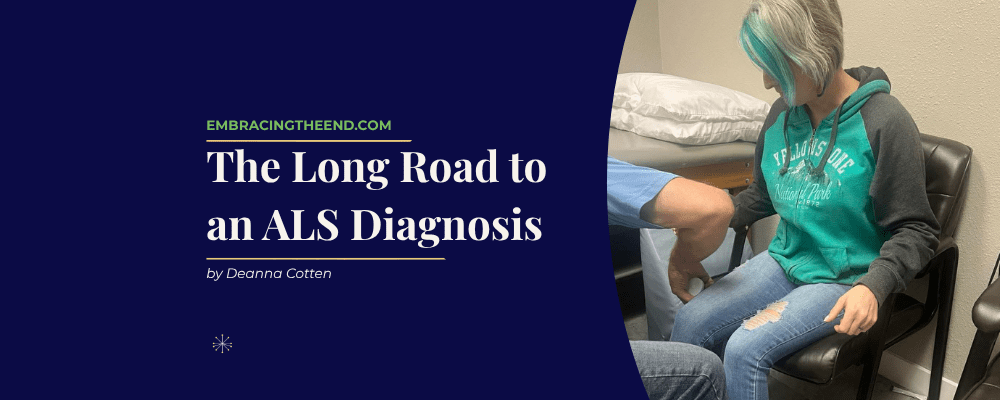
ALS has one of the most complicated diagnostic processes leading to a long, traumatic road to diagnosis. The diagnostic process is almost more traumatizing than the diagnosis itself. If you’re scrolling Tik Tok’s or sitting in a Facebook group right now wondering if anyone else has experienced what you’re experiencing, this post is for you.
The number one question I get asked is what were your symptoms at onset or diagnosis. You’re not asking out of general curiosity. You’re asking because you’re experiencing symptoms that align with ALS and you’re probably being dismissed by doctors. You’re desperately trying to make sense of what is happening in your body. Your body is slowly debilitating and you’re being told it’s anxiety or functional… followed by; go to trauma therapy and physical therapy.
But if you’re like me… I’d been in trauma therapy for 18 months prior to my ALS diagnosis and physical therapy for more than two years for one limb or a another. Although I’m an advocate for mental health, physical, occupational and speech therapies, I wasn’t improving with treatments… I was slowing declining. The kind of slow decline that might get missed in a seven minute appointment.
I Didn’t Know What ALS Was
When I was diagnosed with ALS in January 2024 I had no idea what it was. So I can’t say I was actively noticing ALS symptoms. What I knew was that something was wrong and I had the mindset that answers came with solutions. I just needed to find the answers.
What I didn’t know was that the answers were going to take years to arrive and that the road to get there would be filled with misdiagnoses, unnecessary surgeries and a medical system that didn’t know what to do with me.
My Symptoms Before Diagnosis
For over three years before my diagnosis I was already seeing doctors for a growing list of symptoms that nobody could connect into a single explanation.
Fatigue that didn’t make sense. The kid that didn’t go away with rest. Weakness in my hands and arms. Increased migraines. Memory and focus issues. Trouble with handwriting. Knocking things over. Tremors. Core weakness. Slurring when trying to read from a script. Shortness of breath… not just during activity… but at rest. The shortness of breath that started with COVID in December 2020 and never fully went away. I was sleeping sitting up. It just kept getting worse.
I had multiple surgeries for nerve compressions. One seemed to help. The other two actually made things worse.
It was about 16 months from the time I first noticed I was struggling to write to the day I finally received a definitive ALS diagnosis. And about eight months after that my pulmonologist traced my symptoms all the way back to that COVID infection in 2020 when a restrictive lung pattern, something commonly seen with neuromuscular diseases, first began to emerge.
That means my onset may have been nearly three years before my diagnosis. I don’t say that to scare you. This is the reality of this diagnosis. It doesn’t mean that what you are experiencing isn’t real though.
How I Was Finally Diagnosed
My diagnosis came via EMG, an electromyography test that measures electrical activity in the muscles. But here is something critically important that most people do not know.
An EMG is the most diagnostic test available but doesn’t definitively diagnose ALS every time. At times, it may be to early to detect. Or muscles tested haven’t been affected yet.
ALS is diagnosed by ruling out everything else first. Conditions that can mimic ALS include MS, Myasthenia Gravis, cervical myelopathy, neuropathy, Lyme disease, Kennedy disease, Spinal Muscular Atrophy and dozens more. Once those are ruled out doctors determine whether a patient meets specific diagnostic criteria.
The three main criteria used are the El Escorial criteria developed in 1990 and revised in 1998, the Awaji criteria developed in 2006 and the Gold Coast criteria developed in 2019. I was diagnosed with Definite ALS based on the El Escorial criteria after other conditions were ruled out.
The EMG Is Not the Only Path to Diagnosis
This is where thousands of patients are falling through the cracks and I need to say it clearly. It’s widely assumed that an abnormal EMG is required to diagnose ALS. That assumption is costing people precious time.
In early ALS the EMG may not pick up the disease yet. The Gold Coast criteria, the most recent and most sensitive diagnostic standard, allows for an earlier ALS diagnosis without requiring an abnormal EMG. A patient can meet the Gold Coast criteria based on clinical findings alone including progressive weakness in multiple regions with no other explanation.
If you’re being told your EMG is normal therefore it’s NOT ALS, please know that this isn’t the whole picture. Push for a second opinion from an ALS specialist or a neuromuscular disease clinic. The Gold Coast criteria exists precisely because the older standards were causing dangerous diagnostic delays.
The Dismissal Problem Is Real
Here is the part that keeps me up at night.
Thousands of ALS patients are being dismissed right now. Their symptoms are being labeled as functional, meaning the medical system is telling them the problem is psychological rather than physical, even as they grow weaker and atrophy in front of their doctors. And, don’t get me wrong. A functional disorder is still very real. But for someone experiencing the true debilitation of a disease like ALS, this isn’t just frustrating, it’s dangerous.
A delayed ALS diagnosis means a patient is deteriorating without access to the resources and services they will desperately need. None of those things move quickly. Power wheelchairs take months to arrive. Caregiver support through Medicaid has waiting periods. Adaptive equipment, voice banking, feeding tube evaluations and respiratory support all require early planning to be effective.
Beyond the practical delays there are potential treatment options available that suggest the possibility of slowed progression. Regardless of how many people feel these medications don’t ultimately change outcomes, it’s wrong to deny those options to a person who meets even the minimum criteria for an ALS diagnosis. That decision belongs to the patient, not to a system that can’t recognize what it’s looking at.
What My Symptoms Actually Were
Since so many people ask I want to be specific because specificity is what helps people find answers.
My earliest traceable symptom was shortness of breath after COVID in late 2020. From there over the following years I experienced fatigue and weakness, difficulty with handwriting and fine motor tasks, trouble holding posture while sitting, left leg weakness, tremors, memory and focus issues and increasing migraines.
My left knee would buckle without warning. My ankles felt unstable. Running through an airport in the fall of 2023 I noticed my calves burning in a way that felt completely wrong for someone who used to run 5Ks on purpose before work.
None of those symptoms screamed ALS to me or to my doctors. They screamed many other things first. Ultimately, the earliest symptom, shortness of breath, led my pulmonologist to believe I had a respiratory onset. The respiratory onset only accounts for approximately 3% of cases. This may explain why diagnosis was delayed more than most.
If You Have Met One Person With ALS
Here’s the most important thing I’ve learned about this disease.
If you’ve met one person with ALS you have met one person with ALS.
We all experience the same symptoms but never in the same order, in the same way or at the same time. Some people lose their voice first. Some lose their hands. Some lose their ability to walk. Some like me start with breathing. The disease doesn’t follow a script and it does not consult a textbook before deciding which direction to take.
But in the end we will all end up in the same place. This disease is 100% fatal and there is no cure. Which is exactly why a timely diagnosis matters so much. Not because a diagnosis changes the outcome but because it changes the journey. It changes what resources you can access, what decisions you can make while you still have full voice and full capacity and how much time you have to do the things that matter most before the disease takes more from you.
You deserve answers. Keep pushing until you get them.
Document Everything. Seriously. Everything.
An ALS diagnosis rarely comes after one or two appointments. This is a long and daunting process. There are mimicking diseases to rule in or out, referrals to specialists, repeat testing and then the part that frustrates patients the most… doctors prefer to watch for progression before they will commit to a diagnosis. This is somewhat understandable. ALS comes with a guaranteed fatal outcome. The fear of being wrong is real.
The problem is that progression in ALS isn’t always obvious. It doesn’t always show up dramatically from one appointment to the next. And if you aren’t documenting what you’re experiencing between appointments you’re walking in empty handed while your body is telling a story your doctors aren’t hearing.
Start documenting ASAP.
Document your fasciculations. Fasciculations are the muscle twitches that are one of the hallmark signs of ALS. They can happen anywhere in the body and they come and go. Take videos when they happen. Your phone camera is your best tool right now. A twitch that disappears before your appointment might as well not have happened as far as your doctor is concerned unless you have it on video or are presenting with twitching right then and there.
Let me add a PS to fasciculations. It’s true that fasiculations alone is most often benign. If your fasiculations present with clinical weakness or atrophy (or both) this means the fasiculations are pathologic in nature. Bear in mind… benign doesn’t mean normal. Don’t let doctors dismiss you’re twitching because they believe they are “benign.” You still deserve answers to even a “benign” condition.
Take photos and videos of your weakness and functional changes. If your hand isn’t working the way it used to, show it. If your gait has changed, film yourself walking. If you’re struggling with tasks you used to do easily, document it.
Take measurements and keep notes. Write down dates, symptoms, what got worse, what stayed the same and what changed. Keep a running log on your phone. It doesn’t have to be formal. It just has to be consistent. Bring this documentation to every appointment. It creates a timeline that is much harder to dismiss than your word alone. And let’s be honest about what you are up against.
The medical gaslighting doesn’t always stop after diagnosis. Unless you are a textbook obvious case of ALS many doctors will still disagree with your diagnosis even after you meet the criteria. This is the nature of fighting a disease with no single definitive test and no cure. Doctors are human and they’re trained on textbooks, diagrams and patterns. When your pattern doesn’t match what they learned in school they second guess themselves and unfortunately sometimes they second guess you.
Your documentation is your evidence. Your timeline is your defense. Keep building it from day one and don’t stop until you have answers.
If You Are Looking for a Starting Point
The ALS Association has a Think ALS tool that my doctor and I both found helpful in guiding us toward answers. It’s not a diagnostic tool but it can help frame conversations with your medical team.
If you’re struggling to be heard by your current doctors ask for a referral to a neuromuscular disease specialist or an ALS certified clinic. They speak this language in a way that general neurologists most often do not.
And if you want to understand more about how ALS is diagnosed and why it takes so long read What Is ALS? What I Wish I’d Known At Diagnosis and ALS Is Not a One Size Fits All Disease.
Both of my books were written from inside this journey including the years of searching for answers before the diagnosis ever came.
Embracing the End was written while fighting for my life in hospice. Grab a signed copy here.
Embracing the End… Again was written when I unexpectedly didn’t die and had to figure out what comes next. Grab a signed copy here.
Want both? Grab the complete bundle and save with free shipping.
Disclaimer: I’m not a doctor or medical professional. Everything I share on this site is based on my own personal experience living with ALS. Nothing on this site should be used to diagnose, treat or make medical decisions. Please consult your healthcare provider for medical advice specific to your situation.


Leave a Reply